A visual field guide to business growth, marketing, sales, community and the next level. Every model on one wall, each with a short explanation of how to use it.
Two boards that everything else hangs on. Read these first.
The whole system01
The profit framework
Attract. Convert. Satisfy. Multiply. Inspire.
1
AttractUnderstand the problem
2
ConvertMake the first offer
3
SatisfyDeliver the promise
4
MultiplyRepeat + relationships
5
InspireReferrals + leadership
Attract & engage: every useful touch-point builds trust
Interestunderstand their problem
Credibilityshare the solution
Inspireshow the outcome
Assistcompelling offer
Taste the steak → reduce friction → build belonging → follow up
A small experience of value is the bridge to a bigger commitment. Make the first taste easy, make them feel they belong, then follow up until it is a clear yes or no. Contact. Make it great.
No marriage on the first date. Earn the next yes.
Van X Profit Framework System, pp. 1–2
The whole system02
Find the constraint
Growth is a connected system. Improve the link that limits the whole chain.
MarketWho?
AttentionNotice us
LeadRaise a hand
QualifyIs there fit?
ConvertCommit
SatisfyGet results
UpsellNext problem
Retain / referRepeat + advocate
The constraint question
If leads doubled tomorrow, what would break first: sales, delivery, cash, quality or the founder? That answer is the only thing worth fixing this month. Score each stage out of 10 and the lowest score names the constraint.
A business scales to its biggest constraint, then no further until it is addressed.
Van X Framework Manual, pp. 2, 21; whiteboards 1–3
Chapter 2
Direction & market
Choose the customer before designing the offer. Decide what to ignore.
Direction & market03
Clarity. Focus. Action.
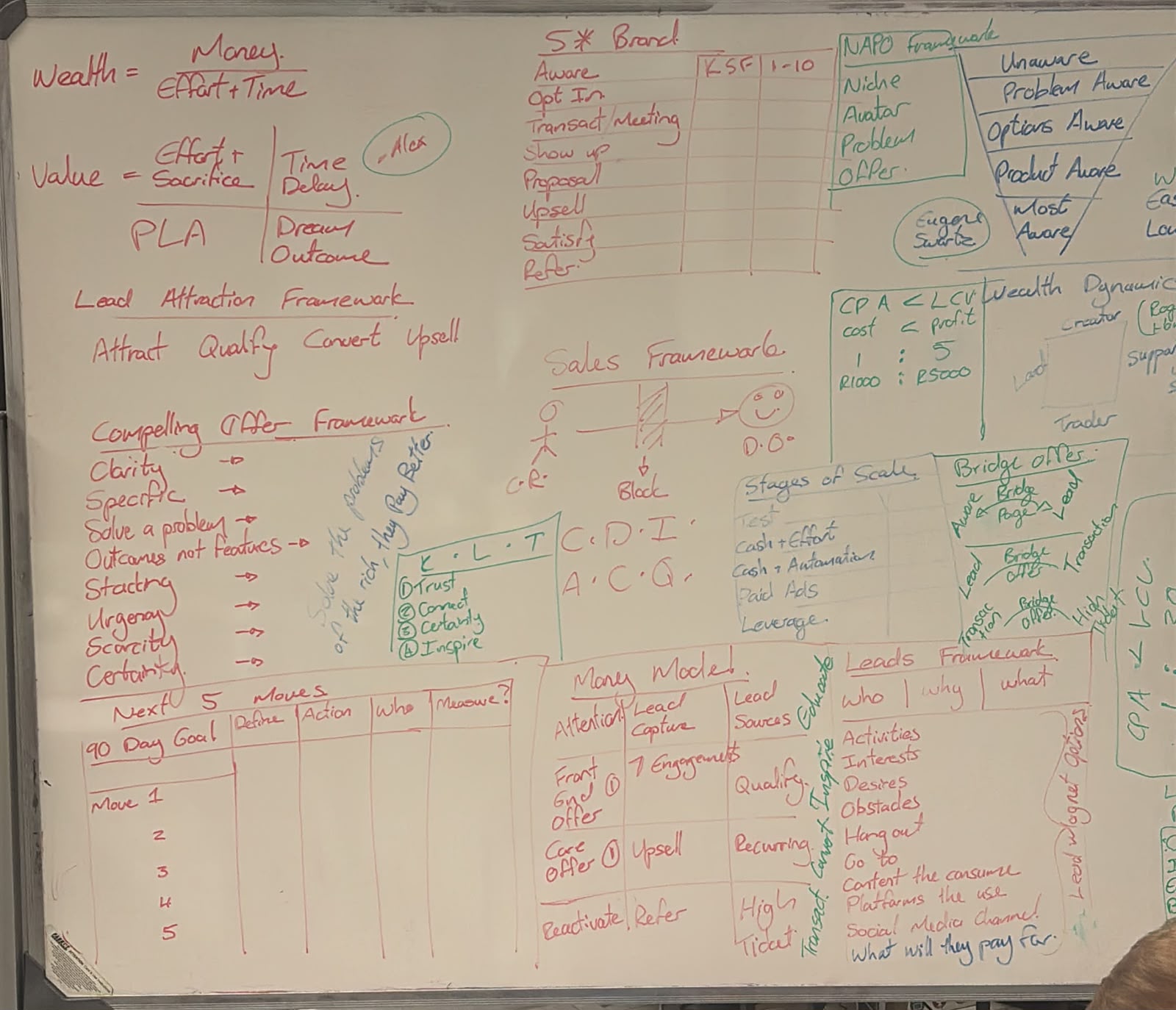
The C.F.A. framework from the workshop whiteboard.
Clarity
Focus
Action
Vision + desiresOutcomeOne 90-day goal
Eliminate distractionsIdentify the constraintStop doing / start doing
Key success factorsDaily activityMeasure results
Review the result. Sharpen the next move.
The loop runs weekly. Clarity is written once per quarter, focus is re-checked each month, action is counted every day.
Clarity sets the destination. Focus removes noise. Action creates evidence.
Whiteboard 3 — C.F.A.
Direction & market04
Work on the business
Move from doing the work to designing how the work gets done.
Wealth = moneyeffort + time
A leverage heuristic, not an accounting formula.
Strategic → VisionDecide where we are going.
Operational → SystemsDesign standards, owners and processes.
Functional → ActivityDo today's tasks and delivery.
The goal is more value with less dependence on your personal effort.
Whiteboard 3 + wealth heuristic from whiteboard 2
Direction & market05
Your next five moves
Translate a 90-day objective into a small number of accountable decisions.
By [date], move [metric] from [baseline] to [target]Protect [quality / profit] while solving [the primary constraint].
Move
Define the outcome
Next action
Owner
Measure
1
2
3
4
5
Five, not fifteen
The few moves that solve the main constraint. If a move does not change the target metric, it is not a move, it is a task.
One owner. One deadline. One visible measure. Review the moves weekly.
Whiteboard 2 — Next 5 Moves
Direction & market06
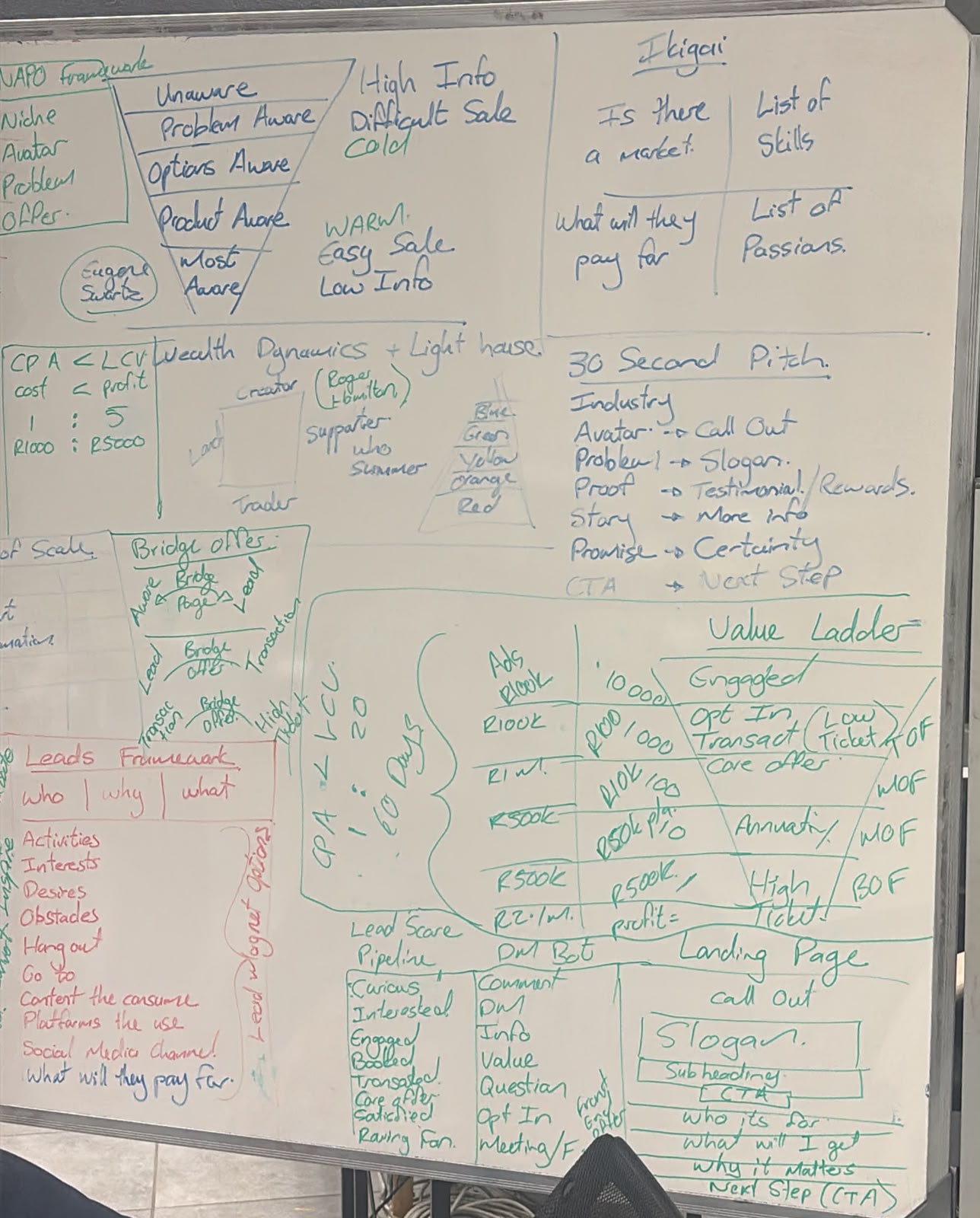
NAPO + the business fit test
Choose the customer before designing the offer.
NicheWhich market?
AvatarWhich person?
ProblemWhat hurts?
OfferWhich result?
MarketIs there a market?
SkillsWhat can I do well?
PaymentWhat will they pay for?
PassionWhat holds my interest?
Business-fit lens
The whiteboard uses "Ikigai" as a business prompt: look for the overlap of the four, then test real demand before committing.
Interest alone is not a market. An attractive offer meets a problem people will pay to solve.
Whiteboard 1 — NAPO and the Ikigai adaptation
Direction & market07
Market selection scorecard
Compare markets on evidence. Score each factor from 1 (weak) to 5 (strong).
Factor
Look for evidence
Score 1–5
Problem value
Cost, urgency, risk and importance
Ability to pay
Budget and willingness to invest
Ease of access
Identifiable buyers and reachable channels
Strategic fit
Skills, credibility, goals and market direction
Profitability
Margin, repeat value and delivery economics
Total / 25 → choose a primary market
The longer manual adds lenses for growth, existing trust and repeat value. Use them as evidence within these five factors. Pick one primary market, park one secondary, deliberately exclude the rest for this 90-day cycle.
An equal-weight score is a comparison tool, not a forecast of success.
Van X Framework Manual, p. 3; expanded workshop framework
Direction & market08
Ideal customer depth
Understand the buying situation, not just a demographic label.
WHO / WHY / WHATthe actual buyer
ProblemWhat costs them money, time or confidence?
OutcomeWhat future do they want?
Past attemptsWhat failed and why?
Trigger + decisionWhy now? Who signs off?
LanguageWhat words do they use?
Objections + proofWhat concerns them? What evidence is required?
Listen for behaviour too
Activities, interests, desires, obstacles, gathering places, content consumed and platforms used. That is the Leads Framework from the whiteboard, and it tells you where to show up and what to say.
Use their language. The avatar is a buying context, not a fictional biography.
Van X Framework Manual, p. 4; whiteboard Leads Framework
Direction & market09
The awareness funnel
Match the message and the commitment to what the buyer already knows.
1Help them recognise the problem.
2Name the cost and possible change.
3Explain the approach and alternatives.
4Show proof, fit and risk reduction.
5Make the offer and next step clear.
Cold → warm
Cold means high information needed and a difficult sale. Warm means low information needed and an easy sale. Build context and trust before a large ask.
Information helps only when it is relevant. Warmth comes from understanding, proof and trust.
Eugene Schwartz awareness stages, as adapted on whiteboard 1
Chapter 3
Offer & economics
Package outcomes, certainty and ease. Then check the maths before you scale.
Offer & economics10
The value equation
Increase desire and confidence. Reduce delay and friction.
Value is perceived before purchase. The buyer must see the result and believe the path.
Alex Hormozi Value Equation, as used in Van X training
Offer & economics11
Build the compelling offer
Start with the outcome, then design the path and remove the obstacles.
A specific customera valuable outcome + a credible mechanism
ClarityEasy to understand
SpecificityFor one real buyer
Solve a problemOutcomes, not features
Stack valueRemove obstacles
Urgency + scarcityGenuine timing and capacity
CertaintyProof + clear terms
The offer architecture, in order
Ideal customer → expensive problem → dream outcome → promise → mechanism → delivery → value stack → proof → guarantee → price → genuine urgency → clear CTA. Solve the problems of people who can pay; they pay better.
Feature → "so that you can" → "which means" → a result the customer values.
Van X Framework Manual, p. 6; whiteboard Compelling Offer Framework
Offer & economics12
The value stack close
Value stack → anchor → bonus → guarantee → price drop → invitation.
Core offerthe main outcome
+ Componentsremove the obstacles
+ Bonusspeed, certainty or support
= Total valuea credible standalone anchor
Would this result be worth it?
Anchor the value of the outcome, not a pile of inflated component prices.
Guarantee
Fair scope. Clear conditions. It moves the defined risk from the buyer to you.
The actual investment: R ____
Make one next step clear. Give a real reason to act. Then be quiet and leave room for the decision.
A guarantee reduces defined risk; it does not make every outcome risk-free.
Brunson-style close; Framework Manual Part 2, p. 1; Van X manual, p. 7
Offer & economics13
The value ladder
Each level delivers a result that makes the next relevant offer logical.
Attention → commitment → lifetime value
Engagenotice / learn
Opt inraise a hand
Low ticketfirst transaction
Core offermain result
Annuityongoing value
High ticketexpand the result
Retention, referral and reactivation
A satisfied customer can buy again, recommend others or re-enter the journey with a relevant new need. That is where the raving fan lives.
The front end is the easiest sensible first commitment, not automatically the cheapest product.
Whiteboard Value Ladder; Van X manual, p. 8
Offer & economics14
Bridge offers + three dates
Move prospects across the gap without forcing the largest commitment first.
Assessment or audit, demonstration or sample, education, pilot or starter, planning session, or an entry transaction. The bridge fits the buyer's awareness, not your preferred product.
"Three dates in 90 minutes" is a teaching metaphor for sequenced commitments, not a conversion promise.
Van X Profit Framework System, p. 3; whiteboard Bridge Offers
Offer & economics15
The money model
Follow the money from acquisition through fulfilment and repeat value.
Acquisition
CACmarketing + sales cost per new customer
Delivery
Gross profitrevenue less direct fulfilment cost
Lifetime value
GP-LTVexpected gross profit across the relationship
CPA < LCV · cost : profit = 1 : 5
Track the ratios
CPL, qualification, booking, show and close rates. Average first transaction, repeat purchases and upsell.
Protect cash + capacity
When is cash collected? When is delivery paid for? How long to recover CAC? Can the team deliver at this volume?
Compare CAC with gross-profit LTV. Revenue is not profit; booked revenue is not cash collected.
Van X manual, p. 21; whiteboards CPA < LCV and Money Model
Offer & economics16
Reverse-engineer the target
A worked planning example. Every rate needs a clear denominator.
R100,000new-sales revenue
10 buyersR10,000 per sale
40 calls held25% close rate
50 bookings80% show rate
100 qualified50% booking rate
200 leads50% qualify rate
The traffic step
At a 10% visitor-to-lead rate, 200 leads require 2,000 relevant visitors. Divide by 30 and you have a daily number. Check unit economics before funding that traffic.
Work backwards to plan; measure forwards to learn. Add existing / recurring revenue separately.
Expanded Money Model; illustrative numbers, not performance claims
Chapter 4
Attraction & campaigns
Whoever controls the flow of leads controls the flow of cash.
Attraction & campaigns17
The Core Four
Who knows you? And are you speaking one-to-one or one-to-many?
Register, book, trial or buy. One action and one clear destination.
Build the marketing muscle
Beginner → consistent → strong → athlete. First clarity, then cadence, then testing, then scale, systems and team. Nobody starts at athlete.
Use the rhythm to build trust. It is a planning aid, not a guaranteed conversion ratio.
Gary Vaynerchuk adaptation; Framework Manual Part 2, p. 3
Chapter 5
Community & nurture
Create useful engagements before making a recommendation.
Community & nurture24
Affiliate marketing framework
Create useful engagements before making a recommendation.
Postearn attention
Free valueuseful quick win
CRM / listcapture with consent
Communitybelong + learn
Engagementsteach + answer
Trialexperience value
Affiliate linkrelevant recommendation
Your role and the partner's role
You create interest and context. The partner's sales, onboarding, support and commissions depend on the programme terms. You do the 1%; they do the rest. Disclose affiliate relationships.
Seven touches is a workshop prompt, not a fixed number required for every buyer.
Framework Manual Part 2, p. 4; Eugene's seven-stage affiliate sequence
Community & nurture25
Community: build it + fill it
Design the place people want to enter, then create the routes that lead there.
BUILD / the five pillars
Welcomestart here
Quick winfirst progress
Core trainingthe method
Community feedpeople + ideas
Gamificationrecognition
FILL / the growth engine
Contentcall-out + story + insight
Lead magnetsuseful value → community
WhatsApp bridgead → WhatsApp → group
Plus events and partnerships that transfer trust.
WhatsApp is attention; the community is retention.
A good community makes people feel seen, progressing and included.
Framework Manual Part 2, p. 5 — Community Profit Framework
Community & nurture26
Community: run it + monetise it
A weekly operating rhythm and a sensible path to deeper value.
MonTraining
TueQuestion
WedWins
ThuLive call
FriCase study
Weekendlight engagement
Freecommunity
Low ticketstarter experience
Coremain programme
VIPcoaching / DFY
Give valueall week
Live callThursday
Invitethe one ask
Value throughout the week. A clear, relevant invitation at the right moment. Sell weekly, not daily.
Framework Manual Part 2, p. 5; prices deliberately left offer-specific
Community & nurture27
The Honey Pot
A destination so useful that the right people enter, stay, share and take the next step.
Contentreel / post
Commenttrigger word
DM botdeliver value
Honey Potcommunity / resources
Foundations / start here
Swipe files + templates
AI & automation kits
Mini-courses
Behind the scenes
Challenges + resources
Value that keeps people coming back
Then one weekly live session that leads to the relevant next offer. A honey pot does not attract everyone; it attracts the people most likely to value the core offer.
Useful content + fast replies + recurring live value + one clear next step.
Framework Manual Part 2, p. 6; Van X manual, p. 9
Community & nurture28
Lead magnets that create buyers
Solve one problem. Reveal the next. Bridge naturally to the paid offer.
MMarket
AAgitate
GGive
NName
EExchange
TTransition
Three jobs
Reveal a problemMake a hidden cost or gap visible.
Trial / sampleLet them experience part of the result.
One step of manyComplete the first step of the larger process.
Four delivery vehicles
Tool / information / service / physicalChoose the format after the job.
"What made you book this call today?" Let them state the problem; whoever describes the problem owns the frame.
L
Label
Reflect the real problem back sharper than they said it. A labelled problem feels half solved.
O
Overview past attempts
"What have you already tried?" Kills the "we'll just do it ourselves" objection early.
S
Sell the vacation
Describe the outcome, not the features. Two minutes max on mechanism.
E
Explain away concerns
Surface risk yourself; answer with evidence. Silence after the price.
R
Reinforce the decision
Confirm next steps and support within 24 hours. Beat buyer's remorse to the punch.
Talk ratio: them 60, you 40.
Diagnose first, prescribe second.
Listen first. Do not use objection handling to push an unsuitable buyer into a purchase.
Hormozi CLOSER adaptation; Framework Manual Part 2, p. 6
Conversion & experience33
The Perfect Webinar
Open with the transformation. Shift belief. Bridge into implementation.
OPEN
PromiseA valuable outcome
AudienceWho this is / is not for
Big dominoThe one key belief
Proof + backstoryWhy you, why this path
TEACH
Secret 1: vehicleThis model can work.
Secret 2: internalI can learn to do this.
Secret 3: externalI can address the barriers.
Student evidenceShow relevant results.
CLOSE
StackWhat they need
Anchor + bonusRelevant added value
GuaranteeClear risk reduction
InviteOptions, timing, CTA
The bridge
Teach a real shift; offer the implementation support that makes the next step practical.
Break the false belief. Rebuild it with evidence. Make the invitation clear.
Russell Brunson adaptation; Framework Manual Part 2, p. 8
Conversion & experience34
The business keynote
A distinct speaking structure for the established-business audience.
Openingrelevance
Credibilitywhy listen
Proofevidence
Principleswhat matters
The enginehow it works
Constraintswhere it stops
Solutionthe method
Big ideachoose your hard
A striking fact needs a source.
Finish with the three relevant ways you can help, then stack, guarantee and close. Keep the options honest and the next action specific.
Teach the business logic, not just the technology or the product.
Framework Manual Part 2, p. 8 — Keynote variant
Conversion & experience35
Two-star to five-star
Map the whole customer experience; improve the moments that shape trust.
Two star
Five star
Slow enquiry, no next step
Prompt reply + clear expectation
Customer chases onboarding
Welcome, timeline, owner, first win
Invisible progress
Proactive updates + visible milestones
Issue bounced between people
One owner + resolution + follow-through
Audit every touchpoint
First impression, enquiry, qualification, buying, onboarding, delivery, communication, recovery, follow-up, repeat purchase and referral. Choose the weakest touchpoint, the highest-emotion moment and the fastest high-trust improvement.
Five-star means clear, dependable and thoughtful, not automatically expensive.
Van X manual, p. 22; Profit Framework System, pp. 1–2
Conversion & experience36
Value stream + the five-star brand
Measure the handoffs and the customer feeling, not only the final transaction.
Do what you say. Look professional. Set expectations. Check satisfaction (rate me 8/10). Make the customer feel safe.
Map before automating. Faster confusion is still confusion.
Whiteboard 2 — 5-star Brand; Value Stream Mapping workshop
Conversion & experience37
Conversion bridge + referrals
Warm the relationship, then make advocacy natural.
Stage
Engagement score
Bridge to
Cold
0–5
Useful download / re-engage
Warm
5–15
Event or meeting invitation
Hot
15+
One-to-one conversation
Raving fan
—
Belonging, shared experiences
Ask the people most able to introduce you
Personal relationships, networks, existing clients and affiliates. Be clear what they should refer you for (level 1, 2 or 3). Then thank, repay and publicly acknowledge. Double one lever nine times and $1,000 becomes $1m.
Reward appropriately: a thank-you, recognition, reciprocal help or a clearly agreed referral fee.
Van X Profit Framework System, pp. 3–4
Conversion & experience38
Multiply + inspire
A useful result can become a lifelong relationship and a wider circle of trust.
Lifelong relationships
Shared experiencesEvents, fun, social connection
Social proofResults others can recognise
Expand the circleInvite a buddy, refer, affiliate
Lead the next levelTeach, mentor, partner; speak to level 1 + 2
Ascension must fit the person
Recontract, renew or expand when the next offer is relevant. Licensing and investment require separate suitability and legal review.
Make customers successful first. Advocacy follows a result worth sharing.
Van X Profit Framework System, p. 2
Chapter 7
Execution & scale
Install the skill, protect the state, solve the constraint of the stage you are actually in.
Execution & scale39
Learn it. Build it. Use it.
Two complementary loops: install a skill and turn a workshop into action.
The skills framework
Get the informationstudy the model
Break it downsimplest useful version
Practise 100 timesreps + feedback
The implementation rhythm
Learnunderstand
Diagnosecurrent reality
Decidechoose
Buildcreate an asset
Commitowner / date
Confidence is not the entry requirement
Practice creates evidence. Repetition → confidence → certainty. Every module ends with a usable asset and a measurable next action.
Framework Manual Part 2, p. 7; Learn-Diagnose-Decide-Build-Commit workshop rhythm
Execution & scale40
The thought-to-cash chain
A coaching model for examining how interpretation affects action.
Thoughtinterpretation
Emotionfeeling
Statereadiness
Energyavailable effort
Cashcommercial result
Use the loop to regain agency
Notice the interpretation. Regulate your state: shoulders back, breathe, "I'm all in". Kill the lie ("I'm not a salesperson"). Choose a useful action. Then measure what happened in the real business.
Mindset influences behaviour. It does not control every circumstance or guarantee income.
Eugene's workshop heuristic; Framework Manual Part 2, p. 7
Execution & scale41
The valley of despair
Expect the learning dip. Build the system that carries you through it.
Leader's response
Shrink the next action, keep the cadence, seek feedback and watch leading indicators. Do not change the whole strategy before the system has had time to learn.
Most people quit in the valley. The ones who make it have a system.
Cycle taught in the Hormozi-style training; Framework Manual Part 2, p. 7
Execution & scale42
The constraints to level up
Solve the constraint of the stage you are actually in.
The next level needs a different capability.
Product-market fitcompelling offer
Be the experttrust + referrals
Get leadslead sources + 1:1 sales
System + AIdocument + automate
Paid advertisingprofitable acquisition
Leverage1:many + partnerships
The four stages of scale, in short
Test → cash with effort → cash with automation → paid ads. There is an order. Skipping it burns cash at stage four or burns you at stage two.
Paid ads are a stage, not a starting identity. Scale only what can be delivered profitably.
Whiteboard 3 — Constraint to Level Up; whiteboard 2 — Stages of Scale
Execution & scale43
Wealth Dynamics
Use strengths to allocate contribution; do not turn a profile into a permanent limitation.
VALUEthrough contribution
CreatorIdeas + products
StarBrand + visibility
SupporterPeople + leadership
Deal MakerRelationships + deals
TraderTiming + transactions
AccumulatorAssets + patience
LordCash flow + control
MechanicSystems + improvement
Read your own profile honestly
Use energy, not competence. Look at your last three real wins and what you personally did. Your opposite frequency is the one you will have to hire.
After the business need is clear: keep, delegate, automate or stop the founder's activities.
Roger James Hamilton / Wealth Dynamics; Van X manual, p. 27
Execution & scale44
The Wealth Lighthouse
Your current level changes which advice is useful next.
Legend
Composer
Trustee
Conductor
Performer
Player
Worker
Survivor
Victim
Move the model
Worker → playerPackage niche value into a priced, repeatable offer.
Player → performerBuild a repeatable team with standards and predictable acquisition.
Performer → conductorLead leaders and allocate resources.
Diagnose evidence, cash flow and dependency, not status or turnover alone.
Roger James Hamilton / Wealth Lighthouse; Van X manual, p. 27
The source notebook45
Source notes + teaching guardrails
A consolidated collection, not a claim that every borrowed framework is proprietary.
Van X Profit Framework SystemFour-page original: the five stages, attraction staircase, first-value experience, bridges, traffic ownership and referrals.
Three workshop whiteboardsNAPO, awareness, pitch, ladders, money model, lead stages, C.F.A., founder pyramid and level-up constraints.
Van X Framework ManualThe structured 29-page reference: customer, offers, economics, experience and implementation.
Framework Manual Part 2The 8-page hand-drawn manual: community, campaigns, VSL, CLOSER, webinar and personal performance.
Earlier workshop workThe expanded frameworks and the MAGNET lead-magnet framework.
Important distinctionsBudgets, touch counts, prices and timelines are examples. Guarantee terms must be real. Unclear whiteboard acronyms are not expanded without confirmation.
The original whiteboards
Named third-party models are credited where used. Apply them with evidence and judgement.